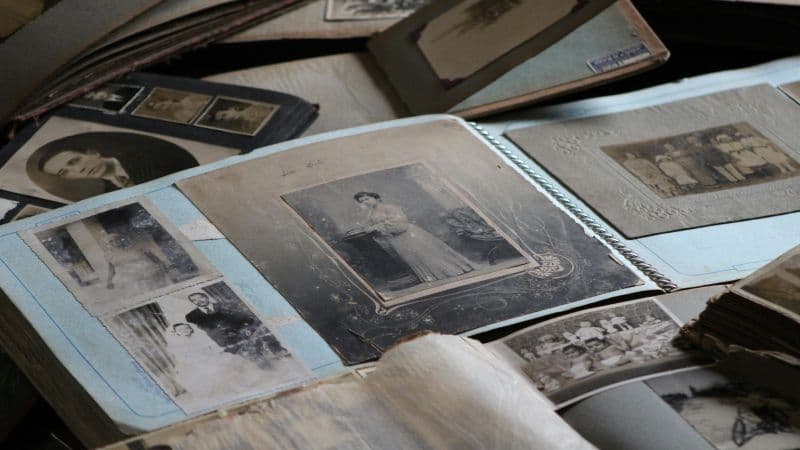
The Case Against Photo Albums in 2026
 Allison HewellJanuary 24, 20267 min read
Somewhere in your home, there's probably a photo album. Maybe it's from your wedding, your child's first year, or a trip you took years ago. When was the last time you opened it?
If you're like most people, you can't remember. Research from Epson found that 86% of people have precious photo albums that never get looked at. They sit on shelves, in closets, and in storage boxes, holding memories that were carefully curated and then forgotten.
Meanwhile, your phone holds thousands of photos you've never organized, and probably never will. Americans take over 200 billion photos every year, yet only about 3% ever make it into any kind of album.
This isn't a failure of willpower. It's a sign that the photo album, both physical and digital, may no longer be the best tool for preserving what matters.
The Problem Isn't You
If you've ever felt guilty about your unorganized photos, you're in good company. The average smartphone user stores roughly 2,400 photos on their device. Nearly 54% of people find it overwhelming to search their camera roll for specific photos from the past.
The math simply doesn't work anymore. We capture far more than we could ever curate. And the gap between "photos taken" and "photos meaningfully preserved" grows wider every year.
Research shows that 60% of people never delete photos, aided by seamless cloud syncing. This digital hoarding creates real consequences: increased stress, reduced productivity, and a sense of being perpetually behind on a project that has no end.
The traditional response to this problem is "just be more organized." But that advice ignores a deeper question: even if you could organize all your photos into perfect albums, would you actually look at them?
What Science Tells Us About Photos and Memory
Here's where things get interesting. Cognitive psychologist Linda Henkel discovered what she calls the "photo-taking impairment effect." In her studies, participants who photographed objects in a museum remembered fewer of them than participants who simply observed. And when they did remember, they recalled fewer specific details.
Taking photos, it turns out, can actually interfere with forming memories.
This happens because we unconsciously outsource the work of remembering to our devices. Researcher Fabian Hutmacher argues that in the digital age, remembering is no longer purely internal. It's an interaction between our minds and our phones. We rely on the camera to remember for us, so our brains don't bother encoding the experience as deeply.
There's a counterbalancing effect, though. Henkel found that when participants took time to zoom in on objects, engaging more deeply with what they were capturing, their memory wasn't impaired. The key variable isn't whether you take photos. It's whether you're mentally present while doing so.
This has implications for how we think about memory preservation. More photos doesn't equal better memories. Engagement matters more than volume.
Why Albums Become Obligations
Photo albums were designed for a different era. When film was expensive and photos were precious, curating a collection made sense. You might take a few dozen photos on a vacation, and turning them into an album was a manageable project.
Today, you might take a few hundred photos on a single weekend. The album approach that worked for your grandparents becomes an impossible burden.
And yet the cultural expectation persists. Baby books, wedding albums, annual family photo books: these rituals carry emotional weight. Abandoning them can feel like admitting you don't care enough about preserving memories.
But there's a difference between caring about memories and committing to a specific memory-keeping system. The guilt many people feel about unfinished albums isn't evidence that they don't value their memories. It's evidence that the system doesn't fit their lives.
Ask yourself: what would serve your future self better? A perfect album you never make, or an imperfect system you actually maintain?
What Actually Helps Us Remember
Research on autobiographical memory reveals something important: we don't remember our lives like photo albums. We remember through multiple senses, emotions, movement, and context.
Studies on video and memory show that videos engage the brain differently than static images. The combination of sight and sound activates more neural pathways, making experiences feel more immersive when revisited. Mirror neurons fire when we observe someone's expressions and movements, allowing us to emotionally reconnect with a moment in ways that photos can't replicate.
This doesn't mean photos are worthless. But it does suggest that a single video clip might preserve the feeling of a moment more effectively than dozens of carefully arranged photos.
Consider what you actually want to remember. The visual composition of a birthday party, or the sound of everyone singing? The perfectly posed family portrait, or the chaotic energy of everyone actually being together?
A Gentler Approach
This isn't an argument that photo albums are bad. For some people, the ritual of creating albums is meaningful in itself. The act of selecting and arranging photos can be a form of reflection. If album-making brings you joy rather than stress, there's no reason to stop.
But for the majority who feel perpetually behind on a project that never ends, it might be worth considering an alternative.
The most sustainable memory-keeping systems share certain characteristics:
They require minimal effort on any given day. A system that demands hours of curation will inevitably be abandoned. One that asks for seconds has a chance of lasting years.
They embrace imperfection. The messy, unedited moments often become the most precious over time. Letting go of curation means actually capturing real life.
They're built for reviewing, not just storing. A memory preserved but never revisited serves no one. The best systems make it easy to look back, not just to add more.
They capture motion and sound. A one-second video of your child laughing contains more than any posed photo could. The voice, the movement, the context: these are what you'll actually want to remember.
For many people, daily video capture fits these criteria better than any album system. The barrier to entry is low. There's nothing to organize. And when you look back, you see your actual life, not a curated version of it.
The Memories That Matter
Here's what it comes down to: what do you actually want from memory preservation?
If the answer is beautiful objects, perfectly arranged, then albums may be right for you. There's genuine value in the tactile experience of a physical book, the intentionality of curation.
But if the answer is emotional connection to your past, the ability to remember how it felt to be you at a specific moment in time, then the volume-over-curation approach of traditional albums may be working against you.
Research on nostalgia consistently shows that people underestimate how meaningful mundane moments become over time. The Tuesday dinner you didn't think was worth photographing. The ordinary morning routine. The unremarkable conversation. These everyday experiences are exactly what we miss most when we look back.
A system that captures these moments without requiring you to judge them as "album-worthy" might preserve more of what actually matters than any perfectly curated collection.
For more on what's worth capturing when nothing special seems to happen, see what to record when nothing interesting happens. And if you're specifically documenting a child's first year, here's how to do it without burning out.
Photo albums aren't failing you. They're just a tool designed for a different era, when we took fewer photos and had more time to arrange them. In 2026, the most effective memory preservation might not look like preservation at all. It might look like small, sustainable daily habits that capture life as it actually is, without the pressure to make it album-worthy.

Allison Hewell
LPC-AContributing Writer & Mental Health Expert
Allison is a licensed therapist specializing in trauma therapy. She writes about the mental health benefits of video journaling and building healthy daily habits.
Connect on LinkedIn